

Description
The Brackish Water Baseline Check is a specialized diagnostic suite designed to establish a definitive chemical and safety profile for any Water Sample (including coastal wells, saline aquifers, estuary inflows, or desalination feed-water). This analysis is essential for determining the degree of salinity and the treatment requirements necessary to make the water potable or fit for irrigation.
What’s tested
Biological
– E.coli/coliform: Qualitative analysis to detect the presence or absence of harmful bacteria (48-hour incubation)
Physical
– pH: Measurement of acidity or alkalinity.
– Electrical Conductivity (EC): Indicator of dissolved mineral and metal content.
– Oxidation-Reduction Potential (ORP): Assessment of the water’s chemical hygiene and sanitization potential.
– Salinity: Concentration of dissolved salts.
– Specific Gravity (S.G.): Measurement of water density relative to pure water.
– Total Dissolved Solids (TDS): The total concentration of all inorganic and organic substances.
Chemical
Full Chemical & Heavy Metal Suite: We analyzes the sample for the following concentrations:
-
Nutrients & Salts: Nitrate, Nitrite, Ammonia, Phosphate, Potassium, Sulfate, and Fluoride.
-
Metals & Heavy Metals: Aluminium, Chromium, Copper, Iron, Lead, Manganese, Mercury, and Zinc.
-
Sanitization & Chemistry: Free (Residual) Chlorine, Total Chlorine, Bromine, Cyanuric Acid, Total Alkalinity, Carbonate Root, and Total Hardness.
Is this the right test for you?
This baseline check is highly recommended for property owners and technicians who:
-
Monitor Saline Sources: You are testing a Water Sample (such as from a borehole near the coast, a tidal creek, or a salty inland aquifer).
-
Notice “Salty” Characteristics: Water that tastes unpleasantly salty, feels “sticky” on the skin, or leaves white crusty deposits (scaling) on equipment.
-
Observe Equipment Corrosion: You see rapid rusting or pitting of metal pipes and fittings exposed to the water.
-
Manage Desalination Systems: You need a baseline report to calibrate Reverse Osmosis (RO) or filtration systems.
-
Protect Agriculture: You are concerned about high salt levels stunting crop growth or affecting soil health.
-
Investigate Seawater Intrusion: You suspect your freshwater well is being contaminated by rising sea levels or over-pumping.
-
Manage Land Risks: You have a septic tank near a saline source or are planning to use the water for recreational purposes.
How it works

How it Works – What’s needed from you?
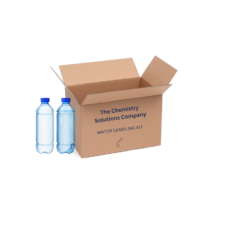
1. Prepare Your Sample Collect 1L of the water sample in a sterile container.
-
For Boreholes: Allow the pump to run for at least 10–15 minutes to ensure the sample is representative of the aquifer rather than the pipework.
-
For Open Water: Collect the sample away from the immediate shoreline to avoid concentrated surface foam or debris.
-
Safety: Do not rinse the container and avoid touching the mouth of the bottle.
2. Complete the Sample Information Card Include a card or letter with the following essential data:
-
Site/Company Info: Full name, phone number, and email.
-
Collection Data: Date and time of collection (critical for Ammonia and Nitrate stability).
-
Source Description: Specify the origin (e.g., “Coastal Borehole,” “Estuary Intake,” “Deep Saline Aquifer”).
-
Specific Concerns: Note if you have seen a recent increase in saltiness or if the water has a “rotten egg” (sulfur) smell.
3. Shipping & Logistics
-
Courier Service: Notify us once the sample is secured; we will dispatch a courier for collection (unless pre-paid).
-
Cold Chain Management: Many chemicals and biological markers are temperature-sensitive. Ensure the sample is packed with frozen gel packs to maintain a temperature of 2°C to 8°C during transit.
Reviews
There are no reviews yet.