

Description
With municipal water costs rising, switching to groundwater is a smart financial move—but only if the water is safe. The Borehole-to-Glass Safety Audit is a specialised diagnostic suite designed to provide a definitive safety profile for your Water Sample (including deep boreholes, shallow wellpoints, or garden wells).
The “Contamination Fingerprint” Our killer feature: We don’t just give you numbers; we provide a Contamination Fingerprint. This analysis cross-references Nitrates, Ammonia, and Bacteria to determine definitively whether your water is potable (drinkable) or if it should be restricted to the garden only..
What’s tested
Biological (The “E.coli Check”)
– E.coli/coliform: Qualitative analysis (48-hr incubation) to detect sewage leaks or animal waste infiltration.
Physical
These measure the “drinkability” and “mouthfeel” of the water while identifying corrosive properties that could ruin your plumbing.
– pH: Measurement of acidity or alkalinity.
– Electrical Conductivity (EC): Indicator of dissolved mineral and metal content.
– Oxidation-Reduction Potential (ORP): Assessment of the water’s chemical hygiene and sanitization potential.
– Salinity: Concentration of dissolved salts.
– Specific Gravity (S.G.): Measurement of water density relative to pure water.
– Total Dissolved Solids (TDS): The total concentration of all inorganic and organic substances.
Chemical
Full Chemical & Heavy Metal Suite: We analyzes the sample for the following concentrations:
-
Nutrients & Salts (The Fertilizer Check): Nitrate, Nitrite, Ammonia, Phosphate, Potassium, Sulfate, and Fluoride.
-
Metals & Heavy Metals (The Plumbing/Industrial Check): Aluminium, Chromium, Copper, Iron, Lead, Manganese, Mercury, and Zinc.
-
Sanitization & Chemistry: Free (Residual) Chlorine, Total Chlorine, Bromine, Cyanuric Acid, Total Alkalinity, Carbonate Root, and Total Hardness.
Is this the right test for you?
This audit is essential if you:
-
Are Switching to Groundwater: You are using a Water Sample (from a new or existing borehole/wellpoint) to save on municipal bills.
-
Fear “Invisible” Contaminants: You are worried about Nitrates from nearby fertilizers or E.coli from aging septic tanks or sewage lines.
-
Have Vulnerable Residents: You have young children, elderly family members, or pets drinking the water.
-
Notice Sensory Issues: The water tastes metallic or bitter, or smells musty/sulfurous.
-
See “System Slime”: You see biofilm or microbial growth in your storage tanks or irrigation pipes.
-
Want Financial Security: You want to ensure your borehole water won’t corrode your expensive appliances (geysers, dishwashers, and kettles).
.
How it works

How it Works – What’s needed from you?
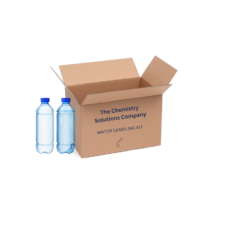
1. Prepare Your Sample Collect 1L of the water sample in a sterile container.
-
For Boreholes: Allow the pump to run for at least 10–15 minutes to ensure the sample is representative of the aquifer rather than the pipework.
-
For Open Water: Collect the sample away from the immediate shoreline to avoid concentrated surface foam or debris.
-
Safety: Do not rinse the container and avoid touching the mouth of the bottle.
2. Complete the Sample Information Card Include a card or letter with the following essential data:
-
Site/Company Info: Full name, phone number, and email.
-
Collection Data: Date and time of collection (critical for Ammonia and Nitrate stability).
-
Source Description: Specify the origin (e.g., “Coastal Borehole,” “Estuary Intake,” “Deep Saline Aquifer”).
-
Specific Concerns: Note if you have seen a recent increase in saltiness or if the water has a “rotten egg” (sulfur) smell.
3. Shipping & Logistics
-
Courier Service: Notify us once the sample is secured; we will dispatch a courier for collection (unless prepaid).
-
Courier Service: Let us know when you’re ready; we’ll send a courier to collect.
-
The “Cold Chain”: Many chemicals and biological markers are temperature-sensitive. For example, Nitrates and bacteria “die off” or change in high heat. Please use refrigeration items (e.g., frozen gel packs) to maintain a temperature of 2°C to 8°C during transit, ensuring your “Fingerprint” is accurate when it reaches our lab.
Reviews
There are no reviews yet.