

Description
As municipal water costs rise, switching to alternative water sources for mechanical systems is a high-ROI move—but only if the chemistry is balanced. The Legacy Asset Protection Suite is a specialized diagnostic audit for your HVAC/BOILER (including cooling towers, chillers, steam boilers, and closed-loop hydronic systems).
The “Corrosion & Scale Fingerprint” Our killer feature: We don’t just give you raw data; we provide a Corrosion & Scale Fingerprint. By cross-referencing Langelier Saturation Index (LSI) factors—such as Hardness, Alkalinity, and TDS—we determine definitively whether your water is Equipment-Safe or if it will lead to the catastrophic failure of your high-value HVAC/BOILER assets.
What’s tested
Biological (The “Bio-Fouling” Check)
Biological (The “Bio-Fouling” Check)
-
Total Coliform & E. coli: Qualitative analysis (48-hr incubation) to detect bacteria that can lead to biofilm buildup (slime). This “biological insulation” coats heat exchangers, drastically reducing thermal efficiency.
Physical (The “System Efficiency” Check)
These measures identify the corrosive properties that could ruin your plumbing.
- pH: Measures acidity —the primary drivers of metal pitting and pipe thinning.
- Electrical Conductivity (EC): Indicator of dissolved mineral and metal load that can lead to conductive corrosion.
- Oxidation-Reduction Potential (ORP): Measures oxidation potential—the primary drivers of metal pitting and pipe thinning.
- Salinity: Concentration of dissolved salts. Critical for identifying brine concentration and the risk of salt-induced degradation
- Specific Gravity (S.G.): Measurement of water density relative to pure water. Critical for identifying brine concentration and the risk of salt-induced degradation
- Total Dissolved Solids (TDS): Indicator of dissolved mineral and metal load that can lead to conductive corrosion.
Chemical (The “Asset Integrity” Suite)
Full Chemical & Heavy Metal Suite: We analyzes the sample for the following concentrations:
- Scale & Hardness Factors: Total Hardness, Total Alkalinity, Carbonate Root, and Sulfate (the primary causes of scale and “glassing”).
- Heavy Metal Leaching Check: Aluminium, Chromium, Copper, Iron, Lead, Manganese, Mercury, and Zinc (to detect if the water is already eating away at your system’s metallurgy).
- Process Chemistry: Free/Total Chlorine, Bromine, Cyanuric Acid, Nitrate, Nitrite, Ammonia, Phosphate, Potassium, and Fluoride.
Is this the right test for you?
This audit is essential if you:
-
Integrate New Sources: You are feeding an HVAC/BOILER system with groundwater or harvested water to reduce municipal expenses.
-
Protect High-Value Assets: You need to ensure your water chemistry won’t corrode copper piping, stainless steel exchangers, or boiler shells.
-
Experience Operational Drop-off: You notice reduced heat transfer, increased energy bills, or “knocking” in boiler tanks.
-
See “System Slime”: You observe biofilm or microbial growth in cooling towers or sumps that could clog valves and sensors.
-
Want Financial Security: You want to avoid the massive capital expenditure of replacing a fouled boiler or a pitted chiller plant.
.
How it works

How it Works – What’s needed from you?
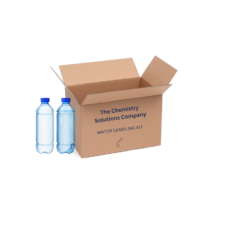
1. Prepare Your Sample Collect 1L of the water sample in a sterile container.
-
For Active Systems: Collect the sample from a designated sampling port or blowdown valve while the system is at operating temperature.
-
For Feed-water: If testing the source before it enters the HVAC/BOILER, run the supply line for 10 minutes to clear stagnant water.
-
Safety: Use appropriate PPE if sampling high-temperature water. Do not rinse the container.
2. Complete the Sample Information Card. Include a card or letter with the following essential data:
-
Site/Company Info: Full name, phone number, and email.
-
Collection Data: Date and time of collection.
-
System Description: Specify the origin (e.g., “Boiler 1 Blowdown,” “Chiller Loop B,” or “Main Feed-water”).
-
Specific Concerns: Note any visible scale, unusual odours, or recent leaks.
3. Shipping & Logistics
-
Courier Service: Notify us once the sample is secured; we will dispatch a courier for collection (unless prepaid).
-
Courier Service: Let us know when you’re ready; we’ll send a courier to collect.
-
The “Cold Chain”: Many chemicals and biological markers are temperature-sensitive. For example, Nitrates and bacteria “die off” or change in high heat. Please use refrigeration items (e.g., frozen gel packs) to maintain a temperature of 2°C to 8°C during transit, ensuring your “Fingerprint” is accurate when it reaches our lab. This ensures an accurate reflection of the conditions inside your HVAC/BOILER.
Reviews
There are no reviews yet.